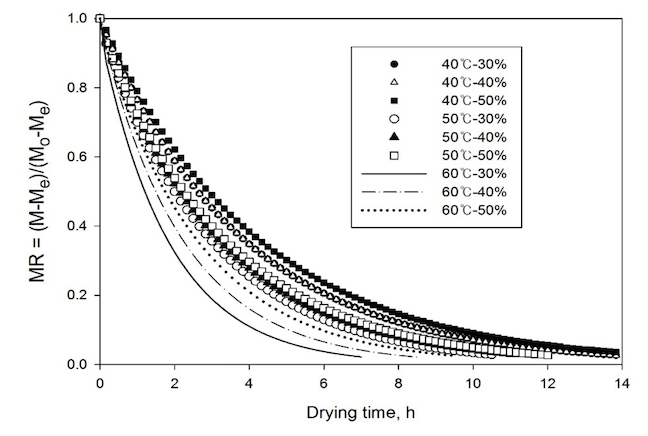
Calculations are based on Page's equation for thin layer drying (Page 1949). The model equation is: MR = exp(-k * t^n). MR is the moisture ratio (dimensionless). The constants k and n are empirical and need to be determined experimentally for each specific material and set of drying conditions. MR is computed as (Mf - Me) / (Mo - Me), where Mo and Mf are the initial and final moisture of the grain. Me is nominally the equilibrium moisture content of the grain at the drying air conditions, though in practice it is fitted rather than measured; see below. Those three moisture contents are on a dry basis (mass of water divided by mass of dry matter). Grain moisture is normally quoted and measured on a wet basis (mass of water divided by total mass), so the calculator converts the values you enter using Mdb = Mwb / (1 - Mwb).
Typical drying time curves for an agricultural grain undering thin layer drying look like the figure above. Separate curves are shown for different ambient temperatures and relative humidity conditions. The k and n constants are used to fit one of these curves.
Factors that affect drying time:
The calculator ships with values fitted to 44 logged runs of a single continuous flow dryer, drying barley, wheat and canola with plenum temperatures of 63 to 90 °C and residence times of 0.5 to 3.2 hours.
| n | 1.0 |
|---|---|
| Me | 6% wet basis |
| k, barley | 0.337 |
| k, wheat | 0.200 |
| k, canola | 0.256 |
Grain type is the largest single influence on k, accounting for about half of the variation between runs. Plenum temperature also has a measurable effect, roughly +0.005 in k per °C, which is about +0.12 across the 63 to 90 °C range covered. The rest of the spread between runs is consistent with measurement error in the moisture readings alone, so there is no point chasing it with a more elaborate model.
Three cautions about these numbers.
First, k, n and Me are not independent, and none of them means anything on its own. Raising Me and lowering n have nearly the same effect on the fit, and k rises steeply with Me. If you fit your own k, fit it at the same n and Me you intend to use.
Second, the 6% Me is not a physical equilibrium moisture content. Air heated to plenum temperature is dry enough that the true equilibrium moisture is only 2 to 3%, but grain leaves the heated section at 31 to 51 °C rather than at plenum temperature, and against those conditions the equilibrium moisture is 5 to 12%. Me must stay below the final moisture or the equation will not invert, which is what limits how high it can usefully be set.
Third, n = 1.0 is pinned, not fitted. Separating n from Me needs runs at deliberately extreme feedrates.
The following is a link to an excellent guide to grain drying systems from UW-Madison.
Comments to the webmaster.
Reference: Factors Influencing the Maximum Rates of Air Drying Shelled Corn in Thin Layers. Page, Glen E. 1949.